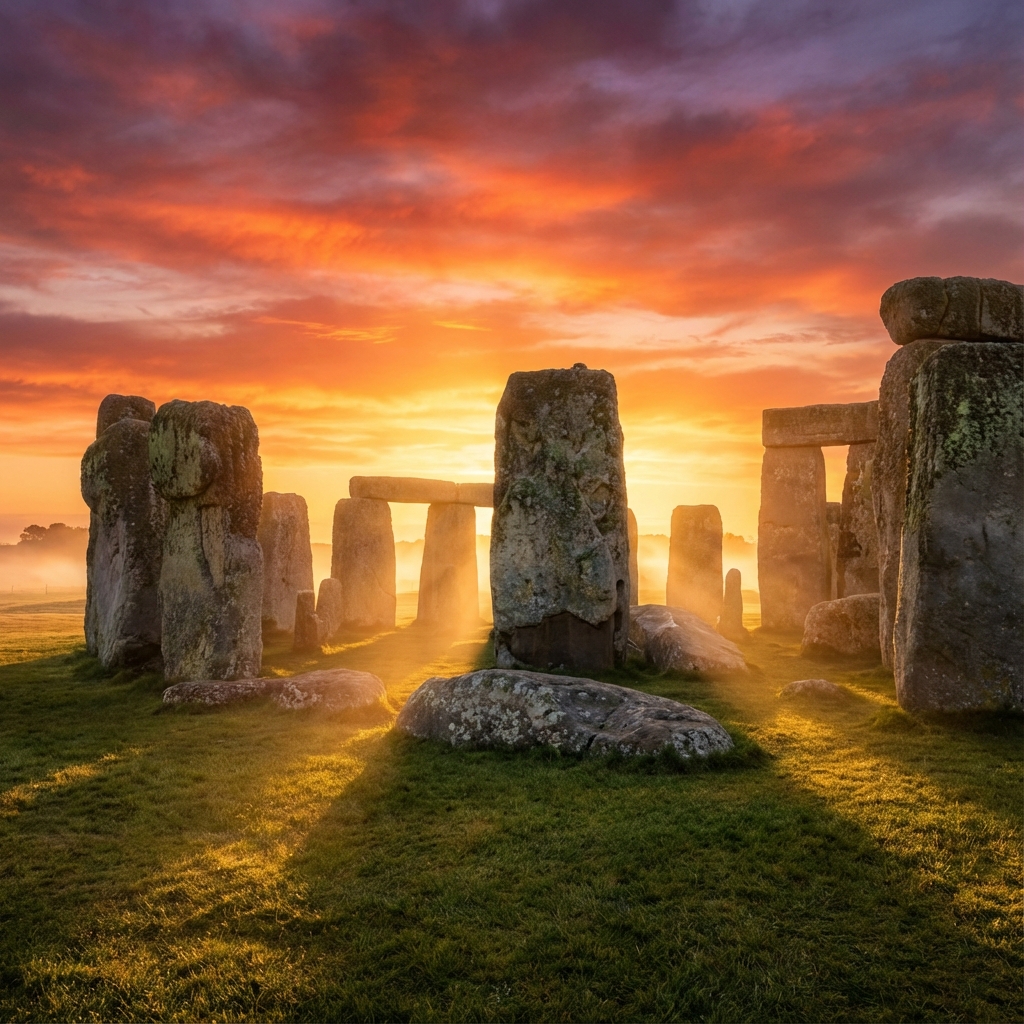
Introduction: An Ancient Riddle
Standing solitary on the rolling plains of Salisbury Plain in Wiltshire, Stonehenge is a silhouette that is instantly recognizable around the globe. It is a masterpiece of engineering, a feats of endurance, and a profound spiritual site that has captivated humanity for millenia. Comprising a ring of standing stones, each around 13 feet high and weighing close to 25 tons, this prehistoric monument is more than just a collection of rocks; it is a testament to the ingenuity and determination of our Neolithic ancestors.
Built in several stages: the first monument was an early henge monument, built about 5,000 years ago, and the unique stone circle was erected in the late Neolithic period about 2500 BC. In the early Bronze Age many burial mounds were built nearby. Today, along with Avebury, Stonehenge forms the heart of a UNESCO World Heritage Site, offering a unique window into the prehistoric past of the British Isles. Despite centuries of study by archaeologists, astronomers, and historians, Stonehenge keeps many of its secrets, maintaining an aura of mystery that draws over a million visitors every year.
The Impossible Build: Engineering Stonehenge
The construction of Stonehenge was a monumental undertaking that spanned some 1,500 years. The first phase, beginning around 3000 BC, was a simple circular earthwork enclosure comprising a ditch and bank. Inside were 56 pits, known as Aubrey Holes, which may have held wooden posts or bluestones. It was a cremation cemetery, the largest known from Neolithic Britain.
The most iconic phase, usually dated between 2600 BC and 2400 BC, saw the arrival of the massive sarsen stones. These giant sandstones, weighing up to 30 tons, were transported from the Marlborough Downs, some 20 miles away. The smaller bluestones, weighing between 2 and 5 tons, have an even more incredible origin story: they came from the Preseli Hills in southwest Wales, over 150 miles away. How Neolithic people, without the wheel or beasts of burden, moved these stones across land and water remains one of the great debates of archaeology. Theories range from roller logs and sledges to ball bearings and treacherous journeys by raft along the Welsh coast and the River Avon.
Once on site, the stones were shaped and dressed using stone hammers (mauls). The lintels were raised to the top of the uprights using a system of weights and levers or earthen ramps. They were secured using sophisticated woodworking joints—mortise and tenon joints—carved into the stone, a clear indication that the builders were skilled carpenters adapting their techniques to a more permanent material.
The Purpose: Temple, Calendar, or Healing Centre?
Why was Stonehenge built? This is the question that has puzzled scholars for centuries. The 12th-century historian Geoffrey of Monmouth claimed it was the work of the wizard Merlin. In the 17th century, John Aubrey and William Stukeley attributed it to the Druids, a theory that persists in popular culture despite the fact that Stonehenge was built a thousand years before the Druids arrived in Britain.
Modern archaeology points to several overlapping functions. The most widely accepted is that it was a prehistoric temple aligned with the movements of the sun. The stones are positioned to frame the sunrise on the summer solstice and the sunset on the winter solstice. This suggests that the site was used for seasonal ceremonies, perhaps to mark the changing of the seasons, crucial for a farming community.
Another theory, proposed by Professors Tim Darvill and Geoff Wainwright, suggests Stonehenge was a place of healing, a prehistoric Lourdes. They argue that the bluestones were believed to have healing powers, citing the high number of burials in the area showing signs of trauma or deformity. Conversely, Professor Mike Parker Pearson argues that Stonehenge was a place of the dead (in stone), while nearby Durrington Walls (structures of wood) was the place of the living, linked by the River Avon in a ritual landscape.
The Solstice Connection
The connection between Stonehenge and the cosmos is undeniable. On the summer solstice (around June 21st), the sun rises behind the Heel Stone, the ancient entrance to the circle, and rays of light channel into the center of the monument. On the winter solstice (around December 21st), the sun sets in the southwest, between the uprights of the tallest trilithon.
Recent evidence from Durrington Walls suggests that the winter solstice was actually the more important celebration. Thousands of animal bones, mostly pigs, were found there, showing signs of having been feasted upon during midwinter. This implies that people gathered from all over Britain to celebrate the turning of the year, the death of the old and the rebirth of the new, in the shadow of the great stones. Today, thousands of people—modern Druids, pagans, and tourists—still gather at Stonehenge on these key dates to witness the alignment, continuing a tradition that is millennia old.
Beyond the Stones: The Hidden Landscape
Stonehenge does not stand in isolation. It is the focal point of a densely packed ritual landscape. Sophisticated geophysical surveys in recent years have revealed that the ground beneath the grass is teeming with hidden history. Hundreds of burial mounds, unknown henge monuments, and cursus monuments (long Neolithic earthworks) characterize the area.
Key sites nearby include Woodhenge, a timber circle similar in design to Stonehenge; the Cursus, a 3km long rectangular enclosure that predates the stones; and the Avenue, a processional route connecting Stonehenge to the River Avon. These discoveries paint a picture of a bustling, sacred landscape where rituals, processions, and burials were part of daily life. The visitor center now displays many treasures found in this landscape, including gold lozenges, amber necklaces, and rigorous tools, bringing the people who built Stonehenge back to life.
Visitor Guide and Tips
Planning Your Visit
Tickets: Timed entry tickets must be booked in advance online.
Location: Near Amesbury, Wiltshire, SP4 7DE. Approx 2 hours drive from London.
Opening Times: Open daily, generally 09:30 – 17:00 or 19:00 depending on the
season.
The Experience
A shuttle bus takes visitors from the modern Visitor Center to the Stones (or you can walk the 1.5 miles through the landscape). An audio guide is available and highly recommended to understand the phases of construction.
Stone Circle Access
During normal opening hours, you cannot walk among the stones; you must stay on the path to protect the fragile archaeology. However, "Stone Circle Experience" tickets are available for early morning or evening access, allowing you to walk inside the inner circle. These are limited and sell out months in advance.
Conclusion
Stonehenge is a silent witness to the dawn of civilization in Britain. It has survived the rise and fall of empires, the ravages of weather, and the curiosity of generations. Whether viewed as a feat of engineering, a celestial calendar, or a sacred temple, its power to inspire wonder is undiminished. Standing before these giant stones, wind sweeping across the plain, one feels a profound connection to the distant past and the human need to leave a mark on the world that outlasts us all.