Introduction: A Window into Rome
In the heart of the golden city of Bath, Somerset, lies one of the best-preserved Roman remains in the world: The Roman Baths. For nearly 2,000 years, visitors have travelled here to bathe in the naturally warm, mineral-rich waters. It is a site of unique historical importance, offering a glimpse into the sophisticated leisure and religious practices of the Roman Empire in Britain.
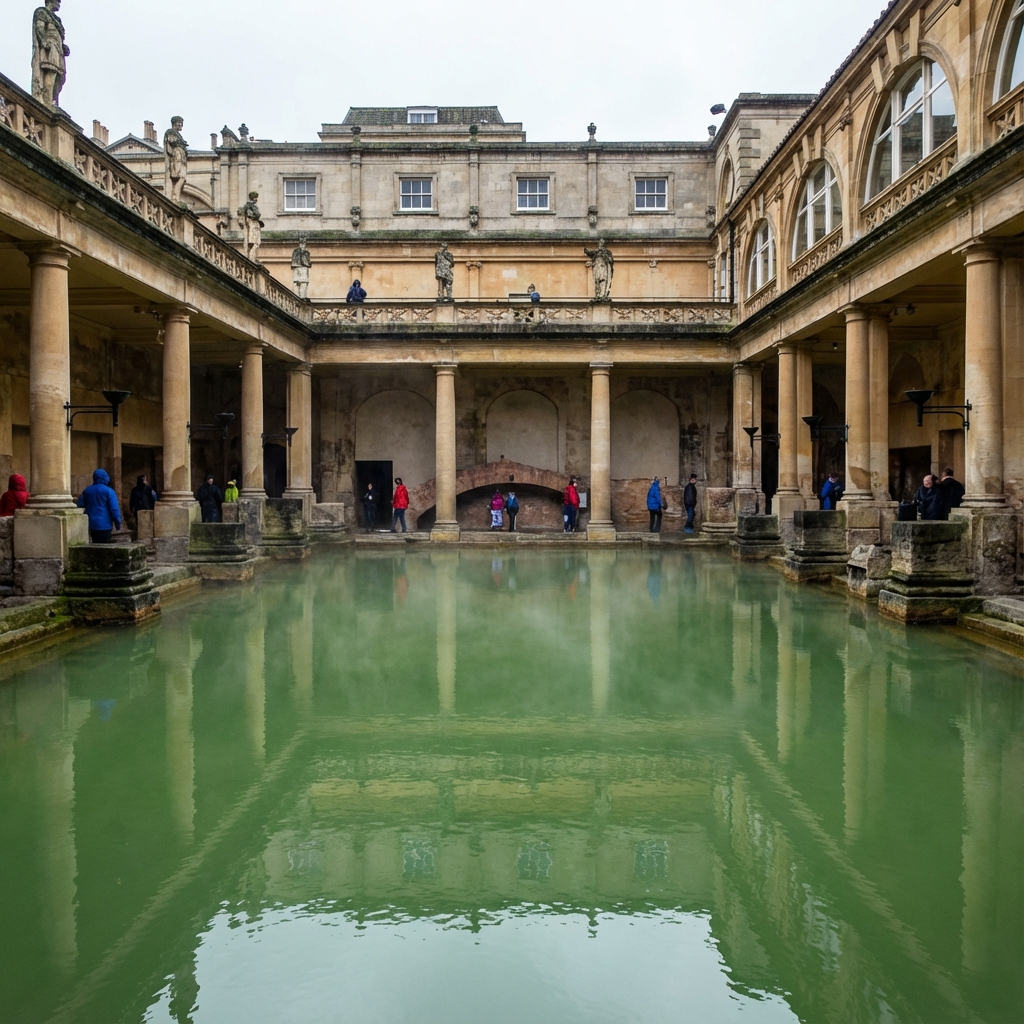
Unlike many ruins that require imagination to reconstruct, the Roman Baths are remarkably intact. The Great Bath, steaming under the open sky, surrounded by Victorian statutes of Roman emperors, is one of the most iconic images of British tourism. But the site is far more than just a pool; it is a sprawling complex of temples, changing rooms, saunas, and plunge pools that extend beneath the modern streets.
The Sacred Spring: Gift of the Gods
The reason for the Baths' existence is geology. Rain that falls on the Mendip Hills sinks deep underground into limestone aquifers, where it is heated by geothermal energy deep within the earth. Under pressure, the water rises back to the surface along fissures and faults, emerging at a constant temperature of 46°C (115°F) at a rate of 1,170,000 litres every day. To the ancient Celts, this hot spring was miraculous, a gift from the goddess Sulis.
When the Romans arrived in AD 43, they identified Sulis with their own goddess Minerva, creating the hybrid deity Sulis Minerva. They built a temple next to the spring, turning a local shrine into a major religious center. The Sacred Spring was enclosed within the Temple precinct, and offerings were thrown into the waters to appease the goddess. Today, the water still flows into the King’s Bath, bubbling up with gas and steam, just as it did two millennia ago.
The Great Bath and Engineering Marvels
The centerpiece of the complex is the Great Bath, a massive lead-lined pool filled with hot spa water. It was originally covered by a high, vaulted roof, which would have kept the steam inside, creating a humid, mysterious atmosphere. The engineering required to build this was immense. The Romans built piles of oak into the mud to provide a stable foundation and lined the pool with sheets of lead extracted from the Mendip Hills.
Surrounding the Great Bath are the remains of a sophisticated heating system. The Romans used hypocausts (underfloor heating) to warm their saunas (laconicum) and warm rooms (tepidarium). Hot air from a furnace flowed through hollow spaces under the floor and through flue tiles in the walls. You can still see the stacks of tiles (pilae) that supported the floors, a testament to Roman ingenuity in creating comfortable living environments even on the harsh edge of the empire.
Voices from the Past: The Curse Tablets
One of the most fascinating discoveries from the Sacred Spring is a collection of 130 curse tablets (defixiones). These small sheets of lead or pewter were inscribed with curses and thrown into the spring, asking Sulis Minerva for justice. They offer a rare and intimate voice of the ordinary people of Roman Britain.
Most of the curses relate to theft at the baths—clothes satisfyingly stolen while the owner was bathing. One famous tablet reads: "Docimedis has lost two gloves and asks that the thief responsible should lose their mind and eyes in the goddess's temple." Another curses the person who stole a cloak, whether "man or woman, boy or girl, slave or free." These messages, scratched in anger 1,700 years ago, connect us directly to the emotions and frustrations of the past.
The Gilt Bronze Head of Sulis Minerva
In 1727, workers digging a sewer discovered a magnificent gilt bronze head of the goddess Sulis Minerva. It is one of the great treasures of Roman Britain. The head would have originally stood within the Temple, looking out over the sacred precinct. The craftsmanship is exquisite, blending classical Roman style with Celtic elements, perfectly symbolizing the fusion of cultures that defined the province of Britannia.
Seeing the head in the museum collection today, with its enigmatic expression and traces of gold still visible, is a powerful reminder of the wealth and devotion that once centered on this site. It stood for hundreds of years before the temple fell into ruin and was lost beneath the mud, only to be rediscovered by a later generation fascinated by the ancients.
The Pump Room and Georgian Elegance
Bathing in Bath didn't end with the Romans. In the 18th century, the city became the premier spa resort of Georgian England. High society flocked here to "take the waters" for their health, drinking the mineral-rich liquid in the Grand Pump Room, which overlooks the King's Bath.
The Grand Pump Room remains a center of social life. Visitors can still sample the warm spa water from a fountain (be warned: it has a distinct metallic taste!) or enjoy a traditional afternoon tea while listening to the Pump Room Trio. The architecture above ground—the statues, the terrace, the Pump Room—is strictly Georgian, creating a unique layering of history where 18th-century gentility sits directly atop 1st-century Roman engineering.
Visitor Guide and Tips
Planning Your Visit
Tickets: Essential to book in advance, especially on weekends and holidays.
Location: Abbey Church Yard, Bath BA1 1LZ.
Opening Times:
Most of the year: 09:00 - 17:00 (Last entry).
Summer evenings: Open until 22:00 for torchlit visits.
Good to Know
- Audio Guide: Included with admission and narrated by Bill Bryson. It's fantastic.
- No Swimming: The water in the Great Bath is untreated and unsafe for swimming. (Thermae Bath Spa nearby offers modern bathing).
- Accessibility: There are lifts to the lower levels, but some ancient paving is uneven.
- Sunset: Visit in the late afternoon to see the torches lit around the Great Bath for a magical atmosphere.
Conclusion
The Roman Baths are a testament to the enduring human desire for health, leisure, and spiritual connection. For two millennia, people have gathered at this sacred spring to heal, to gossip, to worship, and to marvel. Walking on the original Roman pavements, seeing the steam rise into the cold air, one feels a direct link to the toga-clad citizens of Aquae Sulis. It is an immersive journey into the ancient world that engages all the senses and leaves a lasting impression of the sophistication of our ancestors.