Introduction: Steps to the Sea
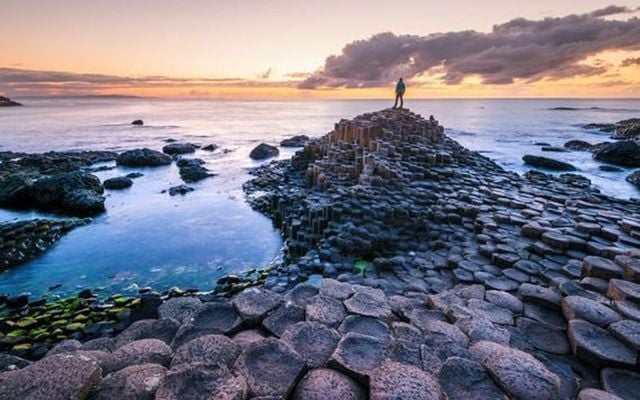
On the rugged North Antarctic coast of Northern Ireland, 40,000 black basalt columns rise out of the sea like a staircase built for titans. This is the Giant's Causeway, the only UNESCO World Heritage Site in Northern Ireland and a geological wonder that defies belief.
The columns are hexagonal (mostly), fitting together so perfectly that water can barely seep between them. They form a pavement that changes height, creating cliffs, stepping stones, and amphitheatres. It is a place of wild, elemental beauty, where the roaring Atlantic Ocean meets the frozen fire of ancient volcanic activity.
The Science: Fire and Ice
Geologically speaking, the causeway is the result of intense volcanic activity during the Paleogene period, some 50–60 million years ago. Highly fluid molten basalt intruded through chalk beds to form an extensive lava plateau.
The science of the shapes is fascinating. As the lava cooled, it contracted. Just as mud cracks when it dries in the sun, the lava cracked. However, because the cooling was slow and even, the cracks formed a regular pattern, extending dowards from the cooling surface. This process, known as columnar jointing, formed the pillars. The taller columns are exposed where the lava pooled in depressions. It is a masterpiece of natural geometry.
The Legend: Finn McCool and Benandonner
If the science sounds too dry, the local legend is far more colorful. It is said that the Irish giant Finn McCool (Fionn mac Cumhaill) was challenged to a fight by the Scottish giant Benandonner. Finn built the causeway across the North Channel so the two giants could meet.
In one version of the story, Finn defeats Benandonner. In another, Finn realizes Benandonner is much bigger than him and flees. His quick-thinking wife, Oonagh, disguises Finn as a baby and tucks him in a cradle. When Benandonner arrives and sees the size of the "baby," he reckons that if the child is that big, the father must be truly gigantic! Terrified, Benandonner flees back to Scotland, tearing up the causeway behind him so Finn cannot follow.
The "proof" is across the sea at Fingal's Cave on the Scottish isle of Staffa, which boasts identical basalt columns—the other end of the ancient bridge.
Exploring the Stones
Walking the causeway is an adventure. The stones have been given names over the centuries based on their resemblance to everyday objects.
- The Wishing Chair: A natural throne formed by a set of columns, polished smooth by thousands of visitors sitting on it.
- The Giant's Boot: A massive rock shaped like a boot, allegedly lost by Finn as he fled.
- The Organ: Massive columns towering high on the cliff face, looking like the pipes of a cathedral organ.
- The Camel: A basaltic dyke that looks remarkably like a camel resting in the bay.
The Cliff-Top Path
While the stones draw the crowds, the Red Trail along the top of the cliffs offers the most spectacular views. From here, you can see the full scale of the causeway jutting into the ocean. The path offers bird's-eye views of the bays and creates a loop that allows you to descend via the Shepherd's Steps—162 steps cut into the cliff face (steep but worth it!).
Birdwatchers will be in heaven here. The cliffs are home to fulmars, petrels, and razorbills. With the salt spray in your face and the wind in your hair, it is an exhilarating experience of the raw power of nature.
Visitor Guide and Tips
Planning Your Visit
Access: The stones themselves are free to visit (public right of way). However, the
Visitor Centre, car park, and audio guide require a ticket.
Location: 44 Causeway Road, Bushmills, County Antrim, BT57 8SU.
Visitor Centre: The award-winning centre is built into the landscape with a
grass roof, blending seamlessly into the hillside. It offers an interactive exhibition explaining
the science and myths.
Getting There
The Causeway Coastal Route is one of the world's great road trips. Alternatively, the rambler bus service connects the causeway to other local attractions like the Carrick-a-Rede Rope Bridge and Dunluce Castle.
Wear Good Shoes!
The stones can be slippery when wet (which is often only in Northern Ireland), and the terrain is uneven. Sturdy walking boots or shoes with good grip are essential.
Conclusion
The Giant's Causeway is a place that touches the imagination. Whether you see the hand of a giant or the forces of volcanology, the result is the same: awe. It is a landscape that feels alien yet strangely beautiful, intricate yet massive. A visit here is not just a walk on some rocks; it is a step into a world of myth and geological wonder that you will never forget.