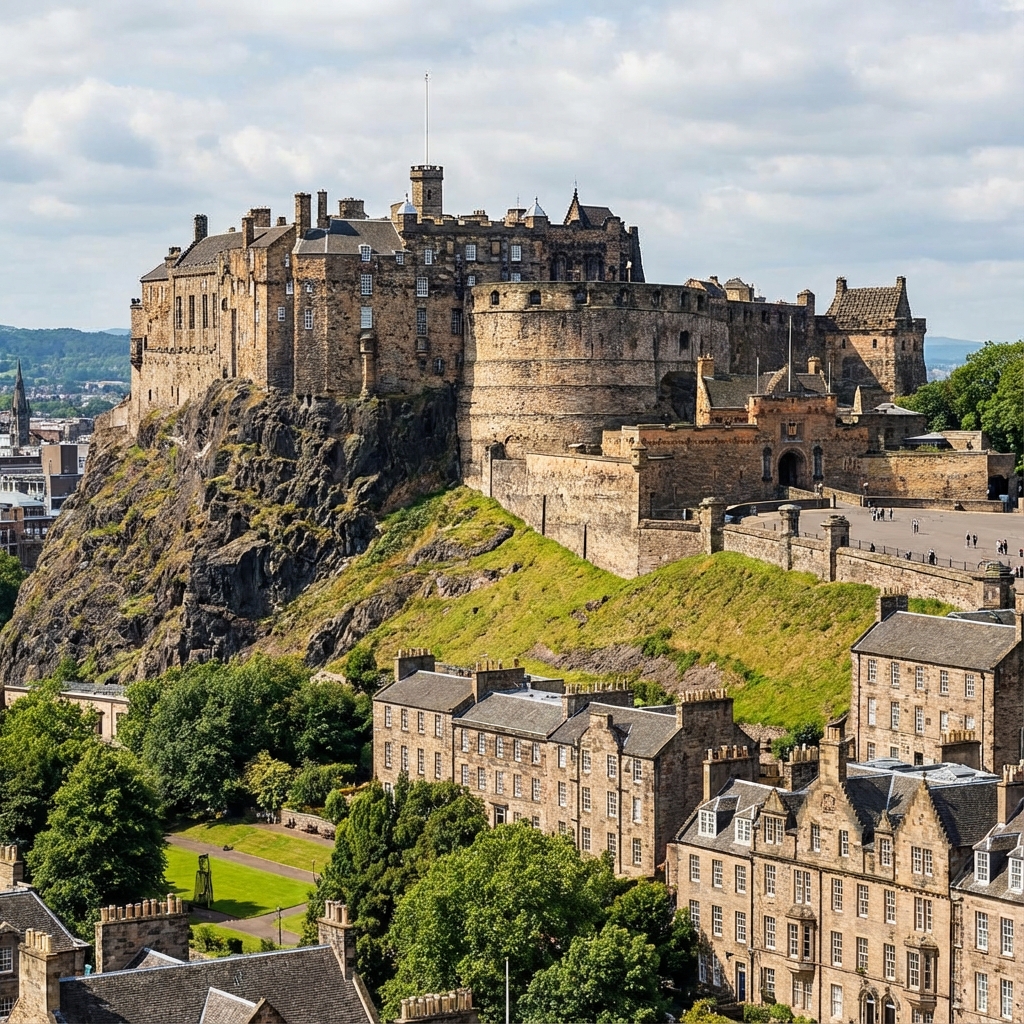
Introduction: A Fortress on a Volcano
Dominating the skyline of Scotland's capital since the 12th century, Edinburgh Castle is one of the most iconic historical sites in Western Europe. Perched atop Castle Rock, an extinct volcano formed 350 million years ago, it naturally commands the surrounding landscape, offering a defensive advantage that has been utilized by humans since the Iron Age. It is the most besieged place in Great Britain and one of the most attacked in the world.
The castle is not a single building but a complex of fortifications, palaces, prisons, and museums. It has served as a royal residence, a military garrison, a prison of war, and a national symbol. From the birth of James VI to the concealment of the Crown Jewels during WWII, its walls have witnessed the pivoting moments of Scottish history. Today, it stands as the guardian of the nation's soul, housing the Honours of Scotland (Crown Jewels) and the Stone of Destiny.
A History of Siege and Conflict
Historically, whoever held the Castle held Edinburgh, and whoever held Edinburgh held Scotland. This strategic importance meant the castle was constantly fought over during the Wars of Scottish Independence. It changed hands between the English and Scots several times. In 1314, Thomas Randolph, the nephew of Robert the Bruce, famously recaptured the castle from the English in a daring night raid, scaling the steep rock face with a small band of men.
The castle's defenses were tested again during the "Lang Siege" (1571-73), when supporters of the exiled Mary, Queen of Scots, held out against the forces of regent James Douglas. The siege ended only when English guns, sent by Elizabeth I, pulverized the defenses, causing the David’s Tower to collapse. The Half Moon Battery, which dominates the eastern side today, was built on top of these ruins.
The Honours of Scotland and the Stone of Destiny
Deep within the Royal Palace lie the Honours of Scotland, the oldest crown jewels in the British Isles. Comprising the Crown, the Sceptre, and the Sword of State, they were first used together at the coronation of the nine-month-old Mary, Queen of Scots, in 1543. Their survival is a miracle in itself; they were hidden in a church floor and burying grounds to keep them from Oliver Cromwell's destroying army. After the Act of Union in 1707, they were locked away in a chest and forgotten for over a century, until Sir Walter Scott rediscovered them in 1818.
Beside them rests the Stone of Destiny (or Stone of Scone). This ancient block of sandstone has been used for centuries in the coronation of Scottish monarchs. Taken by Edward I of England in 1296 as spoils of war, it resided in Westminster Abbey for 700 years until it was returned to Scotland in 1996. It will only leave Scotland again for a coronation in Westminster Abbey, as was seen for King Charles III.
St Margaret's Chapel: The Oldest Survivor
Amidst the military batteries and grand halls, a tiny, simple building stands out: St Margaret's Chapel. Built around 1130 by David I and dedicated to his mother, Queen Margaret (later Saint Margaret), it is the oldest surviving building in Edinburgh. It survived the sieges and demolition attempts—thanks partly to being used as a gunpowder store in the 16th century—and was restored in the 19th century. Today, its stained glass windows and Romanesque arch offer a quiet space of contemplation. It is still used for weddings and christenings for castle staff.
The One O'Clock Gun
Cover your ears! Every day at exactly 1:00 pm (except Sundays, Good Friday, and Christmas Day), the One O'Clock Gun is fired from the Mills Mount Battery. This tradition dates back to 1861, originally devised as a time signal for ships in the Firth of Forth to check their chronometers.
While modern navigation no longer requires it, the ceremony is a beloved Edinburgh tradition. Crowds gather to watch the District Gunner verify the time and fire the modern 105mm field gun. It is a startling reminder of the castle's active military precision.
The Great Hall
The Great Hall, completed in 1511 for James IV, is a masterpiece of medieval architecture. Its most striking feature is the hammerbeam roof, one of the most significant of its kind in Britain. Originally a place for royal banquets and events, it was later converted into barracks for soldiers and a military hospital, with its beautiful roof hidden above false ceilings. It was restored to its former glory in the Victorian era and is now filled with weapons and armor, standing as a symbol of Scotland's royal past.
Visitor Guide and Tips
Planning Your Visit
Tickets: Booking online in advance is essential as timeslots sell out.
Opening Times:
Summer (Apr-Sep): 9:30 - 18:00
Winter (Oct-Mar): 9:30 - 17:00
Must-Do
- See the Crown Jewels: The queue can be long, so go early or late in the day.
- The Prisons of War: Atmospheric recreation of the vaults where French, American, and Spanish prisoners were kept.
- The National War Museum: Located within the castle walls, detailing Scotland's military history.
- The View: The view across Edinburgh to the Firth of Forth is unparalleled.
Conclusion
Edinburgh Castle is more than a monument; it is the physical embodiment of Scottish resilience. From the craggy rock it sits upon to the crown jewels it protects, every inch of the complex tells a story of survival. As you walk down the Royal Mile away from the castle, you leave with a sense of the turbulent, proud, and magnificent history that has shaped not just a city, but a nation.