Introduction: A Repository of Human History
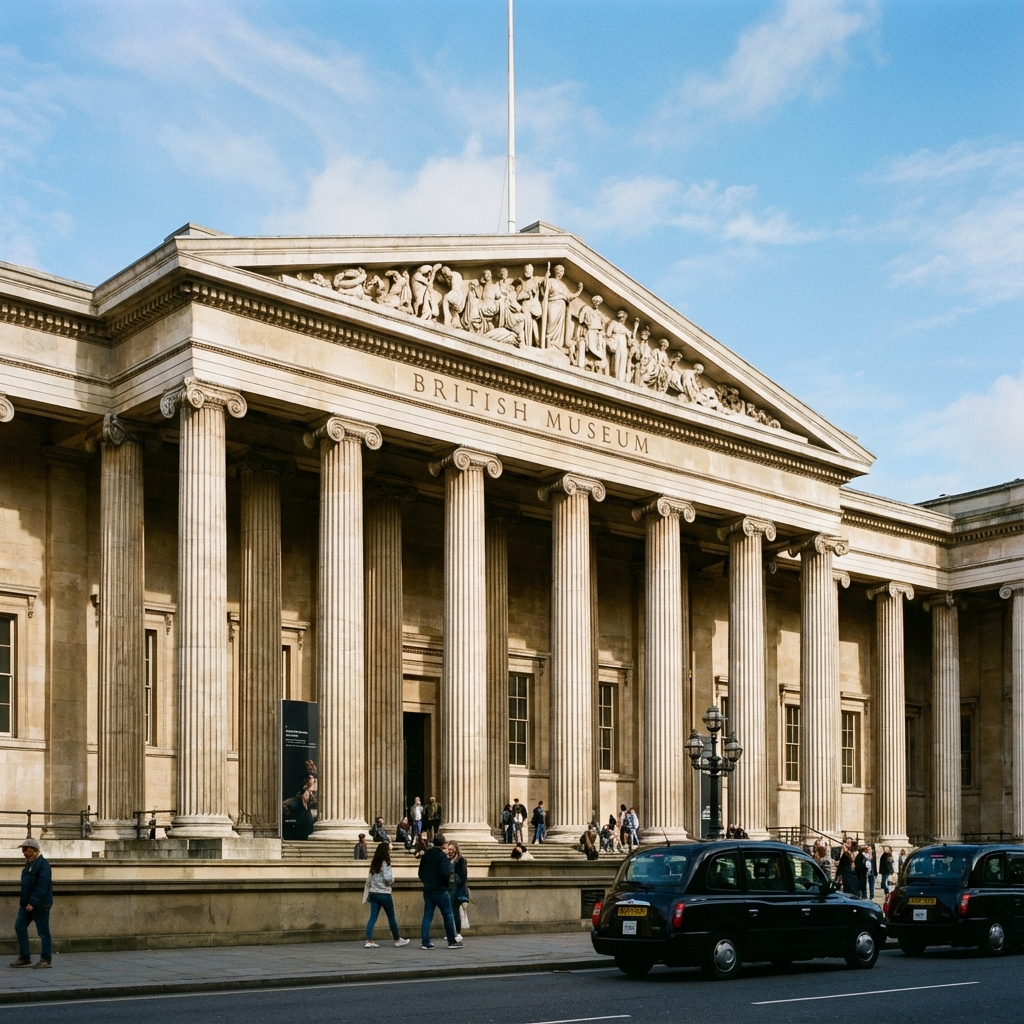
The British Museum, located in the Bloomsbury area of London, is one of the world’s greatest museums of human history and culture. Since opening its doors in 1759, it has stood as a beacon of Enlightenment thought, driven by the desire to understand the world through the study of material culture. Its permanent collection, numbering some eight million works, is among the largest and most comprehensive in existence, originating from all continents, illustrating and documenting the story of human culture from its beginnings to the present.
Unlike many other museums that focus on the art or history of a single nation, the British Museum is truly universal. Its galleries traverse time and space, allowing visitors to walk from ancient Egypt to imperial China, from the dawn of civilization in Mesopotamia to the modern cultures of Africa and Oceania, all under one roof. It is a place where boundaries dissolve, revealing the interconnectedness of human societies across thousands of years.
The Founding and Architecture
The museum owes its existence to the physician and naturalist Sir Hans Sloane (1660–1753). Over his lifetime, Sloane gathered an encyclopedic collection of curiosities, books, endless manuscripts, and natural history specimens. Unwilling to see his life's work dispersed after his death, he bequeathed it to King George II for the nation. The British Museum Act of 1753 formally established the institution, the first national public museum in the world.
Originally housed in Montagu House, a 17th-century mansion, the museum quickly outgrew its space. The current Greek Revival building, designed by Sir Robert Smirke, was constructed between 1823 and 1852. Its design, reminiscent of a classical temple with its grand colonnade of 44 Ionic columns, was intended to reflect the wondrous objects it housed. The most recent major addition is the Great Court, designed by Foster and Partners and opened in 2000. By enclosing the inner courtyard with a spectacular tessellated glass roof, it created the largest covered public square in Europe, transforming the museum’s circulation and acting as a symbolic center for its global collections.
The Rosetta Stone: Unlocking Ancient Egypt
Without a doubt, the single most famous object in the British Museum is the Rosetta Stone. Discovered in 1799 by French soldiers rebuilding a fort in Egypt, this granodiorite stele became the key to deciphering Egyptian hieroglyphs. Before its discovery, the language of ancient Egypt had been a mystery for over a millennium, its wisdom locked away in symbols that no one could read.
The stone features a decree issued at Memphis in 196 BC on behalf of King Ptolemy V. The genius of the stone lies in the fact that the decree appears in three scripts: the upper text is ancient Egyptian hieroglyphs, the middle portion is Demotic script (used for daily purposes), and the lowest is Ancient Greek. Because scholars could read Ancient Greek, they could use the stone as a dictionary to crack the code of the hieroglyphs. This breakthrough, largely attributed to Jean-François Champollion and Thomas Young, opened up vast chapters of human history that had been silent for centuries.
Displayed in the Egyptian Sculpture Gallery, the Stone is often surrounded by crowds. Yet, its significance cannot be overstated. It represents the power of translation and the enduring human desire to communicate across the ages. It is a humble-looking rock with a broken edge, but its intellectual weight is immense.
The Parthenon Sculptures (The Elgin Marbles)
Perhaps the most controversial and aesthetically stunning artifacts in the museum are the Parthenon Sculptures, also known as the Elgin Marbles. These classical Greek marble sculptures were made under the supervision of the architect and sculptor Phidias and his assistants. They were originally part of the temple of the Parthenon on the Acropolis of Athens, completed in 432 BC.
The collection includes about half of the surviving sculptures: 75 metres of the frieze, 15 metopes (carved panels), and 17 pedimental figures. They depict scenes from Greek mythology, including the birth of Athena and the battle between Lapiths and Centaurs, as well as the Panathenaic procession. The sheer artistry of these works is breathtaking; the drapery of the goddesses looks like fluid water rather than stone, and the anatomical precision of the horses and figures remains a benchmark for Western art.
The sculptures were removed from the Parthenon by Lord Elgin, the British ambassador to the Ottoman Empire, in the early 19th century. At the time, the Parthenon was arguably being damaged by neglect and conflict. Elgin claimed he had permission from the Ottoman authorities, a claim that remains debated. Today, the Greek government actively seeks their return to Athens, arguing they belong in their original context. The British Museum maintains that they are part of a shared world heritage and are best displayed in London as part of a global narrative. This ongoing debate adds a layer of modern political complexity to the ancient beauty of the marbles.
Ancient Egypt and Sudan
Beyond the Rosetta Stone, the museum’s collection of Egyptian antiquities is the largest and most comprehensive outside the Egyptian Museum in Cairo. The galleries dedicated to Egypt are vast, filled with colossal statues of pharaohs like Ramesses II (the Younger Memnon), whose sheer size and serene expression inspire awe. This granite statue alone weighs 7.25 tons and required complex engineering to transport from the Ramesseum in Thebes to London.
However, it is the collection of mummies and coffins that captures the public imagination most intensely. The museum houses over 140 mummies and coffins, offering a profound insight into ancient Egyptian beliefs about death and the afterlife. The "Ginger" mummy (a Predynastic man preserved naturally by hot sand) and the elaborate, gold-leafed coffins of the New Kingdom tell stories of ritual, hope, and the human refusal to accept death as the end.
Sutton Hoo: The Anglo-Saxon Ghost Ship
In 1939, on the eve of World War II, a discovery in Suffolk changed our understanding of the so-called "Dark Ages." The excavation of a ship burial at Sutton Hoo revealed a treasure trove of Anglo-Saxon artifacts of exquisite craftsmanship. The most famous object is the Sutton Hoo Helmet, an iron helmet featuring panels of tinned bronze and decorated with a face mask that seemingly stares back across the centuries.
Alongside the helmet were gold jewelry, silverware, and feast vessels, suggesting that the grave belonged to a great king, possibly Raedwald of East Anglia. This discovery proved that early medieval England was not a primitive backwater but a society with sophisticated trade links stretching to Byzantium and Scandinavia, and a culture capable of producing art of the highest order.
The Reading Room: Where Minds Met
At the center of the museum lies the Round Reading Room. For roughly 140 years, this room was a sanctuary for some of the greatest minds in history. Karl Marx wrote *Das Kapital* here; Lenin and Trotsky were visitors; Bram Stoker and Sir Arthur Conan Doyle researched their novels under its domed ceiling.
Although the books have largely moved to the British Library at St Pancras, the room itself remains a magnificent architectural space. Its restoration was a key part of the Great Court project. Standing in this room, one can almost hear the scratching of pens that shaped the 20th century. It serves as a reminder that the British Museum is not just a place for objects, but a place of ideas.
Controversies and the Modern Museum
In the 21st century, the British Museum finds itself at the heart of global debates about decolonization, restitution, and the ethics of collecting. The origins of many items in the collection—acquired during the era of the British Empire—are scrutinized. Beside the Parthenon Sculptures, the Benin Bronzes (looted from Benin City in 1897) are a focal point of this discussion.
The museum approaches these complex issues by emphasizing its role as a "museum of the world," arguing that it provides a unique context where cultures can be compared and contrasted side-by-side. It is also increasingly engaged in long-term loans and collaborative projects with museums in the countries of origin. Engaging with these controversies is now an essential part of the visitor experience, prompting questions about who owns history and how it should be told.
Visitor Guide and Tips
Planning Your Visit
Admission: Entry to the permanent collection is free. Special exhibitions usually
require a paid ticket.
Opening Hours: Daily 10.00–17.00 (Fridays until 20.30).
Location: Great Russell Street, London WC1B 3DG.
Must-See Route (90 Minutes)
- The Rosetta Stone (Room 4): Get there at 10 am to beat the crowds.
- Assyrian Lion Hunt Reliefs (Room 10): Incredibly dynamic ancient carvings.
- Parthenon Sculptures (Room 18): Take time to admire the details.
- The Easter Island Statue (Room 24): Hoa Hakananai'a, a masterpiece of Rapa Nui art.
- Sutton Hoo Helmet (Room 41): Located on the upper floor.
- Lewis Chessmen (Room 40): Charismatic 12th-century walrus ivory chess pieces.
- Japanese Galleries (Rooms 92-94): For Samurai armor and serene art.
Facilities
The Great Court is the hub for food and shopping. There is a pizzeria and a more formal restaurant under the glass roof, along with several cafés. The museum shops offer high-quality replicas, books, and gifts.
Conclusion
The British Museum is more than a building filled with old objects; it is a testament to the endurance and creativity of the human spirit. It tells the story of how we have lived, worshipped, fought, and created beauty for two million years. While it faces modern challenges regarding the provenance of its treasures, its value as an educational resource and a bridge between cultures is undeniable. To walk its galleries is to take a journey around the world and through time, realizing that despite our differences, the human story is one shared heritage. A single visit is never enough to uncover all its secrets, but it is enough to change the way you see the world.